There were many parts of summer I hated when growing up. From fourth through eighth grade, playing in the local Cinderella Softball League required that you practice next to a sewage treatment plant in a swampy valley that was buggy in addition to stinking to high heaven. I had a slew of untreated pollen allergies, which meant rubbing my red eyes with my right hand while swatting away mosquitos with my mitt.
Though I grew up in a small city, I had plenty of access to what we called “the sticks.” I had no overriding passion for rural America, probably because in Western New York, rural meant poor. But thanks to novels, stories, and paintings, I fell in love with the summer landscapes of pre-industrial America.
It started with the Laura Ingalls Wilder books, where scenarios about the volatile frontier—twisters out of nowhere killing this person but not that—implanted in my mind a chronic tension between land and atmosphere and the moments before this tension erupts. In high school, Willa Cather novels picked up the thread of God-like illumination: “long fingers of light reached through the apple branches as through a net; the orchard was riddled and shot with gold; light was the reality, the trees were merely interferences that reflected and refracted light.”
It wasn’t just the wide-open prairies but the shellacked grandeur of mountains, valleys, and waterfalls in the vistas of Thomas Cole and Frederic Edwin Church. Their paintings’ strangeness in regard to color and perspective was as seductively alien as the backdrop landscapes in those Time-Life dinosaur books.
My romanticized American landscape could be frightening, deceptive, and aggressively incongruous with an enterprising culture’s relentless quest for tidy domestication. But it existed because its mystical beauty made people want to write and paint pictures. I didn’t want to live in these imagined places or necessarily to even be there. It was all feeling, and for me it was part of being American.
This mythic landscape would periodically become vividly real thanks to weather and the workings of the sky. It wasn’t until my twenties that I paid attention to the cycles within a season and noted the intensity of late-July thunderstorms. Native Americans called the July full moon the thunder moon. Settlers called it the hay moon—you made hay while the storm clouds gathered.
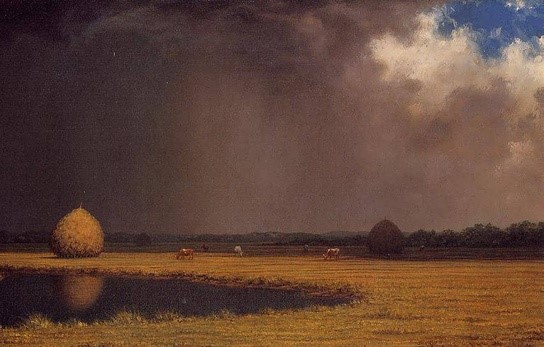
The idea of late July really took hold after I saw an exhibition of Martin Johnson Heade paintings at Boston’s Museum of Fine Arts. In haystack-dotted salt marshes and seascapes, Heade showed his obsession with New England’s atmospheric light and weather effects, particularly the encroachment of dark storm clouds on a sunny sky, so that segments of an otherwise innocuous rural landscape are eerily illuminated with pin-hole beams. His luminous canvases seem to me stories about the sky.

Heade’s undulating convergence of color—the grays, the aubergines, the burnt ochres and umbers—together with a heart-stopping stillness make his narratives feel like a dream of a lost world. I once bought a book of Billy Collins poems because of its cover illustration—Heade’s Salt Marsh Hay (1865)—and its title, Picnic, Lightning, taken from a passage in Nabokov’s Lolita: “My very photogenic mother died in a freak accident (picnic, lightning) when I was three.”
It’s not hard to see the sensual appeal of late-July weather. For a decade, I rented an apartment in a house built for Cambridge orchard workers in the time of William James. The apartment’s Victorian cottage character lent it a romantic aura in the advent of a summer storm—the billowing curtains, the shades getting sucked tight to the windows with the crazy barometric pressure. At the end of July, that apartment could seem like the fourth chamber of a beating heart.
Thunderstorms have always proved a worthy metaphor for passionate though doomed love affairs. There’s a song by a band called Sarge (from the 2000 album Distant) that goes “At the end of July all my plans changed”—about discovering a lover’s betrayal when you were away and coming back home to start over alone. Many of us have these impressions about weather and places that shape our relationship to the world. I myself find it hard to unravel the strands from firsthand observation of land and sky, from literature and art, from my subjective view of American history, and maybe even from my hopes and disappointments about romantic love.
But since, say, 2006, I’ve watched my mythic summer landscape become even more untethered from reality. That was the year An Inconvenient Truth told most of us what we already knew. I began noticing the change in July thunderstorms in the Boston area in 2009, with flash torrential downpours sans any kind of spiritual prelude. They’d come-a-courtin’ with just a smack, like a falling body hitting pavement.
The last week of this past July, a rare and steep summer dip in the jet stream stretched from Canada to the Gulf of Mexico, triggering unusual and severe weather over the eastern U.S.—tornados in Iowa and persistent, torrential rains in the Mid-Atlantic. Meteorologists were astounded by the extreme nature of this jet stream pattern and the fact that it was stuck in place—day after day of remarkable, disruptive weather. In New York City it’s been like this for almost three weeks.
The timing last weekend of the New York Times Magazine’s “Losing Earth: The Decade We Almost Stopped Climate Change,” by Nathaniel Rich, is no surprise. Rich chronicles how between 1979 and 1989, scientists reached consensus about human-caused climate change and politicians nearly came to a global-scale solution. He attributes our failure to take action to human nature, arguing that “we have not allowed ourselves to comprehend what failure might mean for us. How will it change the way we see ourselves, how we remember the past, how we imagine the future?”
Sadly, it tends to be during the summer crescendos of weather extremes that our normalization of climate devastation accelerates. That the reboot of Mamma Mia! hit movie screens just as Greece was grappling with horrifically deadly wildfires barely registers as irony. Twin wildfires constituting the largest wildfire in California’s history have already consumed roughly 980 square miles, burning through an area almost the size of Los Angeles and producing a “fire tornado” with winds more than 143 miles per hour.
It’s hard to believe that the landscapes and weather patterns that inspired so much art just a century ago are changing before our eyes. But it’s even harder to believe that we as a country were in a position to do something about this when I was still a teenager mentally conjuring this gossamer vision of summer into existence. It was already 100% illusory way back then. And now, well . . . at the end of July all my plans changed. §
 Demands Fabulous Fees